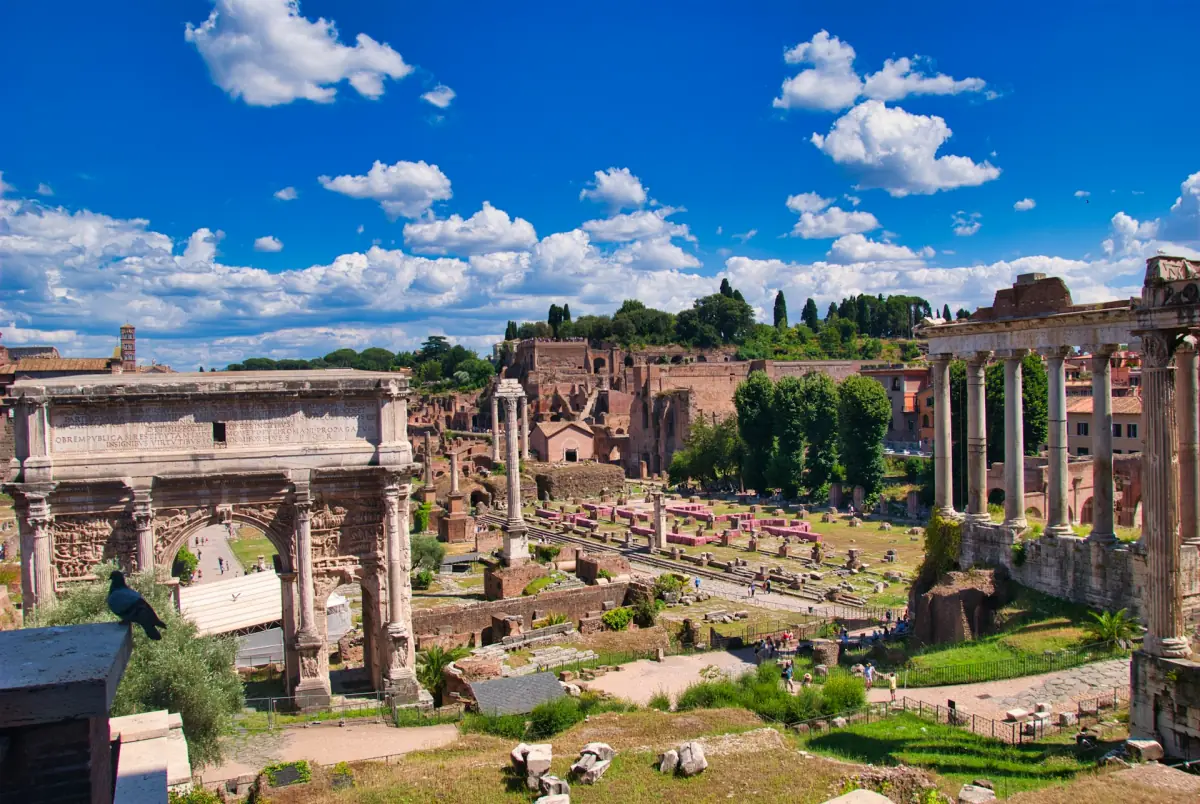
Things to do in the Roman Forum at a glance
The main things to do in the Roman Forum are walking the Via Sacra, seeing the Temple of Saturn and the Arch of Titus, climbing the Palatine Hill and adding the Imperial Forums with Trajan's Markets. The standard 24-hour ticket for 18 euros covers the Colosseum, the Forum and the Palatine Hill, so one ticket opens most of the list below.
The 12 stops are grouped by where they lie. Stops 1 to 4 are on the central square and the Via Sacra, stops 5 to 8 lead from the temples up to the Palatine Hill, and stops 9 to 12 reach the Imperial Forums, Trajan's Markets and the guided visits. Do not climb on columns or wall blocks, and keep to the marked paths.

On the central square and the Via Sacra (1 to 4)
The Roman Forum began as a marshy valley floor and became the public centre of Rome from the late 7th century BC.
1. Walk the Via Sacra
The Via Sacra ties the temple and square areas of the Roman Forum to the climb toward the Arch of Titus and the Palatine Hill. Start at the Largo della Salara Vecchia entrance and follow the ruins in a loose loop; a suggested order is on the Forum map and route. It is a planning aid, so closed paths and interior opening times come first. Walking it first gives you the layout before you study single buildings.
2. See the Temple of Saturn
The Temple of Saturn stands at the foot of the Capitoline Hill and is one of the ancient cult sites of the Roman Forum. It also housed the Aerarium, the state treasury of Rome. The surviving inscription recalls a restoration after a fire. It suits a short stop on the central square for anyone curious about how Rome stored its money.
3. Stand beneath the Arch of Septimius Severus
The Arch of Septimius Severus dates to 203 AD and has three passageways at the foot of the Capitoline Hill. It honours victories over the Parthians and is dedicated to Septimius Severus and Caracalla; the name of Geta was removed after his murder. In the Middle Ages it served as a fortification and was partly buried before modern excavation. The story of those digs is in the Roman Forum history.
4. Look into the Curia Julia
The Curia Julia was the Senate house, begun by Caesar and completed by Augustus in 29 BC. Inside are an opus sectile marble floor, coloured marble walls and steps for about 300 senators' seats. The bronze door you see is a copy. The Curia is on the Forum Pass and Full Experience lists, but interior opening can vary from day to day.
Our picks: things to do in the Roman Forum
The guided Colosseum, Forum and Palatine visit covers the three big sites in one go, while the audio app entry suits a quick look at your own pace.
Hand-picked tours, booked through GetYourGuide. Prices are indicative starting prices in euros (as of November 2026). Tap a tour for live availability and the current price in your currency.

Guided tour of the Colosseum, Forum and Palatine Hill
Colosseum, Forum and Palatine Hill entry plus headsets are included. Hotel pickup, food and tips are not, and the arena depends on the option you choose.
Check availability →
Colosseum, Forum and Palatine with underground option
The Forum and Colosseum are included, with either the underground or the arena depending on your option. You choose a live guide or an audio guide. Transport and food are extra.
Check availability →
Colosseum, Palatine and Forum with a guide
- Colosseum, Forum and Palatine entry
- Guide and headsets

Ancient Rome at your own pace
- Colosseum, Forum and Palatine entry
- Multilingual audio guide app
The Colosseum uses a booked time slot. Arena and underground access are not included.
Check availability →Roman Forum tours and tickets
Guided walks of the Forum and the Palatine Hill, combined entries with the Colosseum and visits to Trajan's Markets, with live prices and availability.
From the temples to the Palatine Hill (5 to 8)
The path leads from the central square of the Roman Forum toward the Arch of Titus and the imperial palaces.
5. Visit the Temple of Antoninus and Faustina
This temple was first built for the deceased Faustina and dedicated to both after Antoninus Pius died in 161 AD. Six cipollino columns carry the front porch. The temple later became the church of San Lorenzo in Miranda, and the high church door shows how much higher the ground was before the excavations. Seeing the ruin does not mean the inside is open to visitors.
6. Find the Temple of Vesta and the House of the Vestals
The round Temple of Vesta held the sacred fire, and the visible building is linked to the restoration under Julia Domna at the end of the 2nd century AD. Next door, the House of the Vestals is built around a courtyard with a water basin and statues of the chief Vestals, which the park describes as copies. Six priestesses tended the fire, each serving 30 years.
7. See the Arch of Titus and its reliefs
The Arch of Titus is a single-bay monument at the start of the climb to the Palatine Hill. The reliefs inside the passage show Titus on his triumphal chariot and soldiers carrying spoils from Jerusalem, including the seven-armed menorah. The scene refers to the conquest of Jerusalem in 70 AD. The arch has its own park entrance next to the Via Sacra.
8. Climb the Palatine Hill
The Palatine Hill carries Iron Age settlement traces and the ruins of imperial palaces. The Stadio Palatino measures 161 by 48 metres, and the Farnese Gardens were laid out from 1537 for Cardinal Alessandro Farnese. As of October 2026 the House of Livia is closed for restoration and the House of Augustus is closed on Mondays.
Imperial Forums, Trajan's Markets and guided visits (9 to 12)
The Imperial Forums lie along the Via dei Fori Imperiali and border the Roman Forum.
9. Walk the Imperial Forums
The Imperial Forums stretch between Piazza Venezia and the Colosseum and are several imperial-era complexes, not another name for the Roman Forum. The Forum of Caesar dates to 46 BC, the Forum of Augustus to 2 BC, the Forum of Peace to 75 AD and the Forum of Nerva to 97 AD. Trajan's Forum followed in the early 2nd century AD.
10. Visit Trajan's Markets
Trajan's Markets and the Museum of the Imperial Forums are at Via Quattro Novembre 94, with their own ticket office. The museum is open daily from 9:30 to 19:30, with last entry one hour before closing, and it is closed on 1 May and 25 December. As of October 2026 the regular price is €15 and the reduced price €9.50. The complex spreads over six levels. The tour listings include a guided visit and a ticket for the markets.
11. Go below the Basilica of Maxentius
The Basilica of Maxentius was begun in 308 AD, and its north aisle still shows large coffered vaults. Beneath it lie the Horrea Piperataria, former spice warehouses. The archaeological park runs a Monday visit there: English at 11:30 and 14:00, up to 10 people, 75 minutes. The price is €26, made up of €18 for the Forum Pass SUPER and €8 for the guide. See the Roman Forum tour options.
12. Take the Friday evening visit
The 2026 programme A Night at the Roman Forum lists guided visits of about 75 minutes on Fridays from 19:30 to 22:00, with last entry at 20:30. Groups are limited to 25 people and booking is required. The price is €35, made up of €18 for the Forum Pass SUPER and €17 for the guide; children under 6 enter free. The route is covered on the page about the Roman Forum at night.
Plan your time at the Roman Forum
From 25 October 2026 until 28 February 2027 the Roman Forum and the Palatine Hill open at 9:00, with last entry at 15:30 and closing at 16:30. The opening hours by season cover other dates. Metro lines B and C both stop at Colosseo, the nearest station, and the getting there guide lists buses and entrances.
The park lists 10 drinking fountains and about 70 benches. A ticket bought online carries a name, and the best time to visit depends on heat and the length of the day. With little time, the audio app entry fits a quick look. For the stories behind the ruins, the guided walks with headsets work better.
Things to do in the Roman Forum: frequently asked questions
Is the Palatine Hill included in a Roman Forum ticket?
Yes. The standard 24-hour ticket for 18 euros covers the Forum, the Palatine Hill and the Museo del Foro Romano, plus one Colosseum visit at a booked time. You get one entry to the shared Forum and Palatine area, so see both before you leave.
Is the Roman Forum free to enter?
Not usually. Entry is free for visitors under 18 and on the first Sunday of each month, plus 25 April, 2 June and 4 November in 2026. On free Sundays the Curia, the Temple of Romulus and the Houses of Augustus and Livia are not open. Otherwise the standard ticket costs 18 euros.
What is the Roman Forum known for?
The Roman Forum is known as the public centre of ancient Rome. After the marshy valley was drained from the late 7th century BC, it hosted political, religious, commercial and legal life. Today visitors see the Temple of Saturn, the Curia Julia, the Arch of Titus and the Via Sacra.
How long does a Roman Forum and Palatine Hill tour take?
The guided Forum and Palatine walks in the tour listings run from 1.5 to 2.5 hours. A visit that adds the Colosseum takes about 2.5 hours. Trajan's Markets have their own guided visit of about 1.5 hours.